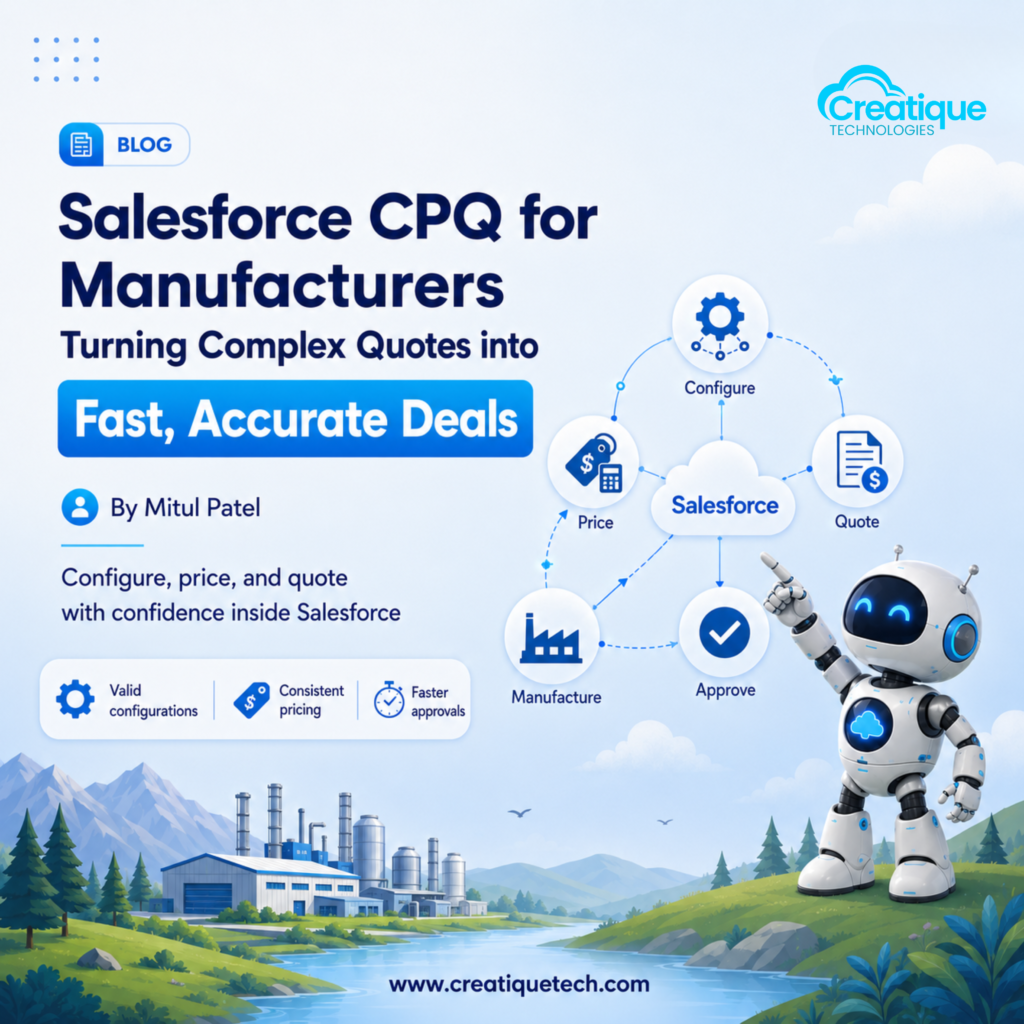
A sales rep at a discrete manufacturer gets a request for a custom configuration: three product variants, a volume discount tier, a regional price list, and an approval chain that runs through engineering and finance. What should take twenty minutes takes three days, because the quote gets built in a spreadsheet, checked against a price book nobody trusts, and routed for approval by email.
This is the moment Salesforce CPQ (Configure, Price, Quote) is built for.
Why Manufacturers Feel This Pain More Than Most
Manufacturing quotes are rarely simple line items. A single deal might involve dozens of SKUs, engineered-to-order configurations, tiered pricing by region or distributor tier, and bundled service contracts. Add in approval rules for discounts above a certain threshold, and a quote stops being a document and starts being a small project.
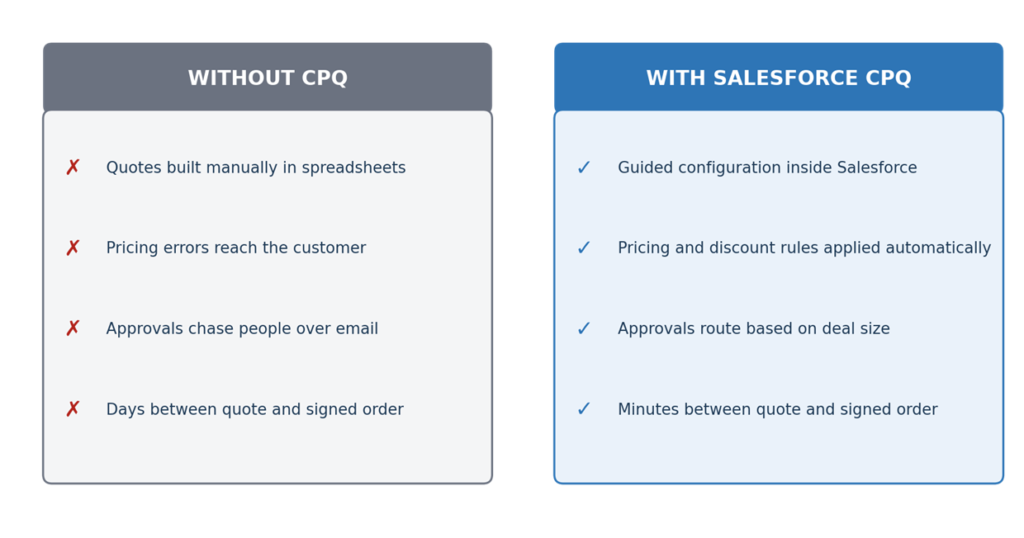
When that process lives outside Salesforce, in spreadsheets and inboxes, three things happen consistently:
- Reps quote the wrong price or an invalid product combination
- Approvals stall because nobody knows whose desk the deal is sitting on
- Finance and engineering find out about a commitment after it’s already been promised to the customer
None of this is a people problem. It’s a tooling problem, and it compounds as deal volume grows.
What CPQ Actually Fixes
CPQ sits directly inside the Salesforce opportunity and handles three things in sequence.
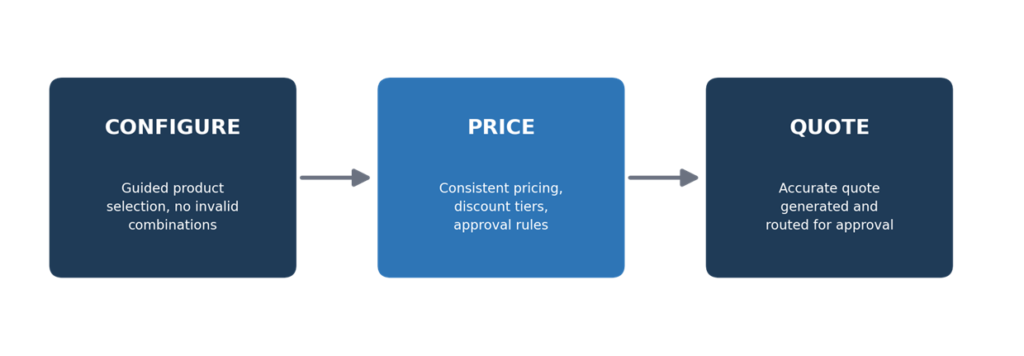
Configure. Guided selling logic stops a rep from quoting a part that doesn’t exist or a combination that violates an engineering constraint. If Product A requires Component B, the system enforces it automatically instead of relying on the rep to remember.
Price. Price rules, volume tiers, contract pricing, and currency or region logic are applied consistently. A rep in Austin and a rep in Ahmedabad quoting the same distributor get the same answer, because the pricing lives in the system, not in someone’s memory of “how we usually do it.”
Quote. The output is a branded, accurate quote document generated in minutes, with approval routing built in based on discount depth, deal size, or margin impact.
The outcome isn’t just faster quotes. It’s fewer quoting errors reaching a customer, and a much shorter gap between “customer wants this” and “customer has a signed order.”
Where This Connects to the Rest of Your Salesforce Stack
CPQ isn’t a standalone tool bolted onto Salesforce. It’s the layer between the opportunity and the order.
If you’ve already aligned your Order-to-Cash process across CRM, ERP, and MES, CPQ is what feeds that pipeline clean, validated data instead of a manually re-keyed quote. And if you’re deploying Agentforce for use cases like automated order processing, CPQ is what makes that automation trustworthy in the first place. An agent can only auto-create an order in ERP with confidence if the quote behind it was configured and priced correctly to begin with.
Get the quoting layer wrong, and every process downstream inherits that error.
Common Mistakes When Rolling Out CPQ
Trying to model every edge case on day one. Manufacturers often have years of pricing exceptions and one-off deals baked into how sales operates. Trying to encode all of it before launch turns a six-week project into a six-month one. Start with your core product lines and most common pricing scenarios, then expand.
Skipping the approval matrix conversation. Who actually needs to approve a 15% discount versus a 30% discount? This should be settled with sales leadership and finance before configuration begins, not discovered after reps start complaining that everything requires four sign-offs.
Treating it as an IT project instead of a sales process change. CPQ changes how reps work day to day. Without training and a clear rollout plan, adoption lags and people quietly go back to spreadsheets.
Getting Started the Right Way
Before configuring anything, get clear answers to a few questions: which product lines have the most quoting friction today, where are the current bottlenecks in your approval process, and what does “correct” pricing actually mean across your different customer tiers and regions.
Then build a pilot around one product line or one sales team. Let them run real quotes through it. Fix what breaks. Only then expand to the rest of the business.
Final Word
Quoting is where deals either accelerate or stall. For manufacturers running complex, configurable products, CPQ isn’t an add-on to Salesforce, it’s the difference between a sales team that quotes with confidence and one that’s still cross-checking a spreadsheet before every deal.
Want to Fix Your Quoting Process?
At Creatique Technologies, we help manufacturers configure Salesforce CPQ around how their business actually sells, connect it cleanly to ERP and order management, and get reps quoting accurately from week one.
Book a free CPQ readiness call with our team today.