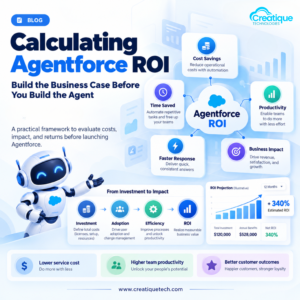
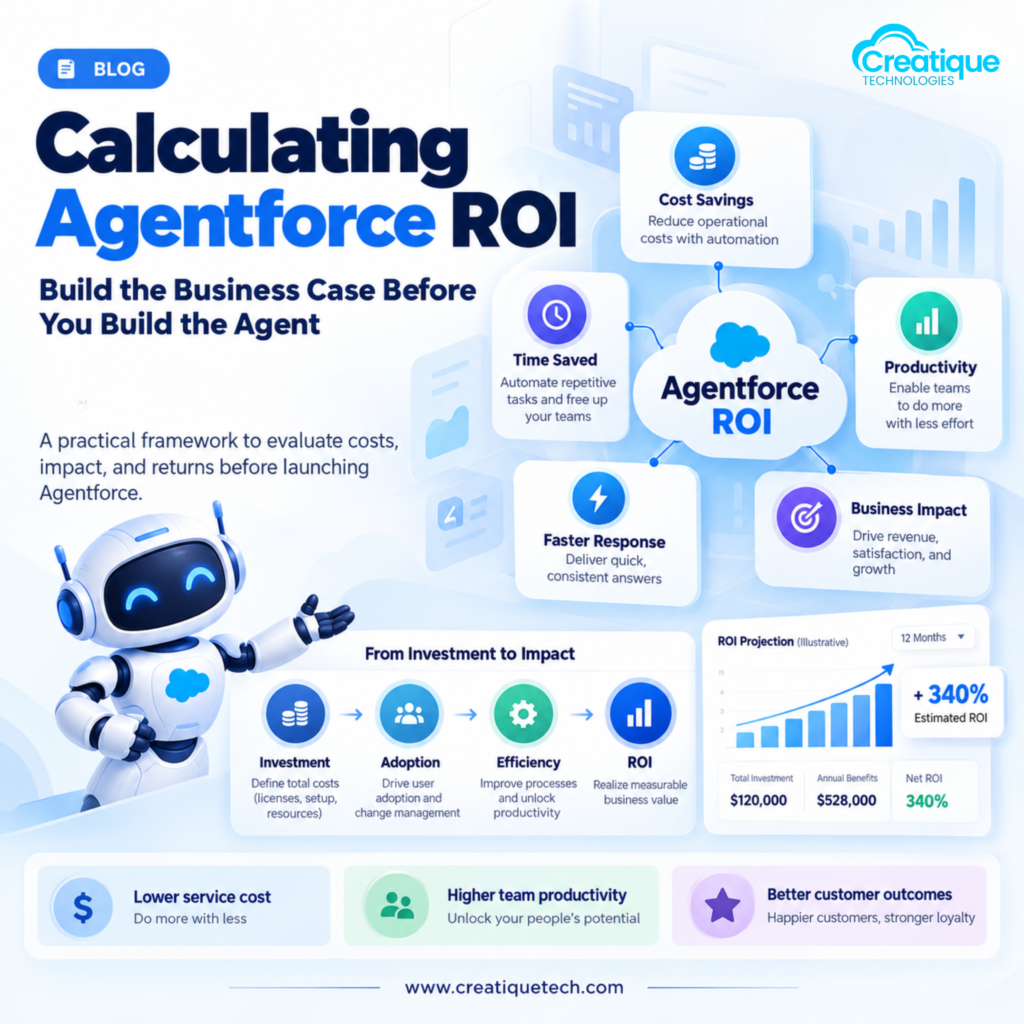
Most Agentforce projects don’t stall because the technology fails. They stall because someone in finance asks a simple question three months in: what are we actually getting for this? If the answer is a vague “efficiency,” the project loses its budget.
The fix is to do the math before you build anything. Not a forty-slide model, just a clear view of what an agent will cost, what it will save, and how you’ll know which one is winning.
Start With the Cost Side, Because It’s Easier Than You Think
Agentforce pricing looks complicated from the outside, but the live options come down to a few meters. As of October 2026, the main ones are:
→ Flex Credits. $500 buys 100,000 credits. A standard agent action uses 20 credits, which works out to about $0.10. A voice action uses 30 credits, about $0.15. → Per conversation. $2 for a customer-facing agent session, available through pre-purchase. → Per-user licenses. From $5 a month for basic access up to $550 a month for Agentforce 1 editions, which bundle credits at the org level.
Which one fits depends on how your agent behaves. Break-even between per-action and per-conversation pricing sits at roughly 20 actions per conversation. Most order-status or case-triage agents run well under that, so Flex Credits usually come out cheaper. An agent that does a lot of work per conversation is the exception.
One detail catches teams out: credits are metered per action, not per token, and sandbox testing also consumes credits, at a reduced rate. Budget for your build and test phase, not just production.
The Costs That Aren’t on the Pricing Page
The agent meter is rarely the biggest line in the budget. When we scope these projects, the larger numbers usually sit elsewhere:
→ Data readiness. If the agent needs unified customer or order data, Data Cloud and its own credit usage may come into play. → Integration work. An agent that checks real order status needs a reliable connection to your ERP. That build is often bigger than the agent itself. → Implementation and tuning. Writing topics, instructions, and guardrails, then testing them against real cases, takes real hours. → Ongoing maintenance. Agents drift as your products, policies, and pricing change. Someone owns that work.
Leave these out and your ROI number will look great right up until the first invoice.
The Benefit Side: Pick Measurable Things
Agentforce benefits tend to fall into three buckets, and only the first two are easy to put a number on.
Deflected work. Contacts the agent resolves without a human. For a manufacturer, think dealer order-status requests, stock checks, warranty claim intake, and routine quote questions. Count the volume, multiply by what each one costs you today.
Time returned to people. Hours your sales reps, service agents, or operations staff stop spending on repetitive steps like data entry, case summaries, or follow-up emails. Be conservative here. Saved time only turns into savings if it gets redirected to something that earns or protects revenue.
Speed and accuracy. Faster quote turnaround, fewer order errors, shorter time to resolution. These are real, but harder to price. Track them as supporting evidence rather than the headline number.
A Worked Example
Here’s an illustrative scenario for a manufacturer with a dealer network. The assumptions are placeholders, so swap in your own.
A dealer-facing agent handles order-status and stock questions. Today those come in by email and phone, and each one costs about $6 in staff time to handle.
→ Monthly volume: 3,000 dealer inquiries → Agent resolution rate: 60%, so 1,800 contacts handled without a person → Actions per conversation: 5 → Agent cost: 3,000 conversations x 5 actions x $0.10 = $1,500 a month → Avoided handling cost: 1,800 x $6 = $10,800 a month → Net monthly benefit before overhead: $9,300
Now the honest part. Subtract your integration build, Data Cloud usage, implementation hours, and ongoing maintenance, and the picture changes. The project may still pay back well, but over months rather than weeks. That’s the number your finance team will want, and it’s the one you want to present before they ask for it.
Notice what also drives this result: the resolution rate. At 30% instead of 60%, the avoided cost halves while the agent cost barely moves. Resolution rate is the lever to watch, which is why it needs to be measured from day one.
How to Build the Business Case
Pick one use case, not a portfolio. A single well-scoped agent gives you a clean before-and-after comparison. Five agents at once gives you noise.
Baseline before you build. Record current volume, handling time, and cost per contact now. You can’t show improvement without a starting point.
Set a target resolution rate and a floor. Decide what number makes this worthwhile, and what number means you rethink the design.
Model three scenarios. Conservative, expected, and strong. If the conservative case still clears your threshold, the decision is easy.
Include the full cost. Integration, data, build, and maintenance sit next to the credit spend, not hidden behind it.
Common Mistakes
Counting hours saved as dollars saved. Unless those hours are redeployed or a hiring plan changes, no cash moves. Be explicit about which one you mean.
Ignoring the escalation path. Contacts the agent hands to a human still cost money, and sometimes more, because the customer arrives frustrated. Measure the quality of handoffs, not just the volume resolved.
Measuring once at launch. Early numbers flatter the project. Review monthly, because usage patterns, product changes, and edge cases shift the picture.
Skipping the pilot. A small, time-boxed pilot with one dealer group produces real numbers. A projection built in a conference room does not.
Final Word
The strongest Agentforce proposals we see aren’t the most ambitious. They’re the ones with a narrow scope, an honest cost estimate, a baseline, and a number that finance can check six months later. Build that case first, and the agent has a much better chance of surviving long enough to prove itself.
Pricing referenced here reflects published rates as of October 2026. Salesforce adjusts plans and rate cards often, so confirm current terms before you finalize a budget.
Want Help Building Your Agentforce Business Case?
At Creatique Technologies, we help manufacturers scope Agentforce use cases, estimate full cost, and set baselines that make results easy to measure.
Book a free Agentforce ROI workshop with our team today.