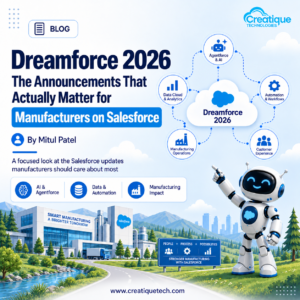
Dreamforce 2026 ran September 15 to 17 at Moscone Center, with over a thousand sessions and the usual wall of keynote announcements. Most of the coverage focused on the biggest headlines: a new interface layer, a new reasoning model, a partnership with just about every major cloud and model provider. It was a lot.
Rather than walk through everything Salesforce announced, here’s what’s actually worth your attention if you’re running Salesforce inside a manufacturing or B2B operation, and what’s just conference noise.
The Big Frame: AIforce
The umbrella announcement was AIforce, described as a new interface layer sitting above Agentforce, Data 360, and Customer 360. The pitch is straightforward: people and agents should be able to use Salesforce’s data, workflows, and permissions from wherever they’re already working, Claude, Slack, or the standard Lightning interface, rather than being forced back into a dashboard every time.
Underneath the branding, this is really an architecture decision Salesforce is calling the Enterprise AI Harness: one consistent layer for context, permissions, governance, and security, with the model and interface choice left open. AIforce launched with three concrete implementations: Salesforce in Claude, Slackforce, and Agentforce Coworker. Every request still runs on existing permissions, so an agent working through any of these surfaces only sees what the person behind it is already allowed to see.
The practical takeaway: your org’s actual value isn’t the interface layer or which model you pick. It’s the quality of the data, permissions, and workflow configuration sitting underneath all of it. That part doesn’t change with any of these announcements, and it’s the part worth investing in regardless of which AI surface your team ends up using.
Koa: Salesforce’s Own Reasoning Model
Salesforce and NVIDIA introduced Koa, Salesforce’s first CRM-specific reasoning model, built by post-training NVIDIA’s open Nemotron architecture on synthetic data modeled after decades of CRM deployment patterns across a wide range of industries. Salesforce says it outperforms general-purpose models specifically on CRM actions, with meaningfully fewer errors, and it runs entirely inside Salesforce’s existing trust boundary.
Koa is in pilot now, with general availability expected in US regions this winter. Just as important as Koa itself is what Salesforce said around it: customers should pick a model based on the price-performance tradeoff that fits the task at hand, not default to one model for everything. Koa, Gemini, Claude, and OpenAI’s models (via Amazon Bedrock) are all positioned as legitimate choices depending on what you’re optimizing for.
The Two Agents Worth Knowing About If You Sell Through Distributors
Salesforce pre-released a portfolio of seven “job-ready” prebuilt agents ahead of the main keynote, and most of the coverage lumped them together. Two of them are directly relevant to the kind of manufacturing operations we work with.
Marshall is built for supply chain and back-office orchestration, things like supplier onboarding, with deterministic execution and a full audit trail. In one live demo, Marshall learned a supplier-onboarding process inside an SAP sandbox and then executed the trusted actions to create and activate a supplier. If you’ve been working through an ERP integration between Salesforce and SAP or Oracle, this is the kind of automation that becomes realistic once that integration layer is solid, not before.
Piper handles inbound engagement and pipeline generation. In a demo built around a distribution scenario, Piper engaged a prospective distribution partner, generated a tailored presentation, and scheduled a meeting with the right account executive. It’s a preview of where dealer and distributor engagement is headed: not just a self-service portal for existing partners, but an agent doing initial qualification and handoff for prospective ones.
The other five, Casey (customer service across voice and digital channels), Fin (a customer agent from Salesforce’s recent acquisition), Paige (internal IT and HR support), Carter (commerce), and Hunter (a longer-horizon sales agent that works a pipeline goal over days or weeks), are worth knowing about, but they map more directly to service and sales operations than to manufacturing-specific workflows. Six of the seven are generally available now; Hunter is in pilot, with general availability expected in November 2026.
Salesforce in Claude Moved to Open Beta
We covered the Claudeforce partnership shortly after it was first announced in August. At Dreamforce, Salesforce confirmed the Sales Cloud skill inside Salesforce in Claude is now in open beta and free for all customers, demonstrated live on stage. If you were waiting for this to move past pilot access before evaluating it seriously, that wait is over. The permissions model we described in our earlier piece still applies: every action runs as the authenticated user, under your existing sharing rules, with no separate access layer to configure.
The Scale Numbers, With Some Skepticism
Salesforce shared a handful of adoption figures worth noting, with the usual caveat that vendor-reported numbers at a keynote deserve a bit of distance. Agentforce is reportedly live with 30,000 customers, and Agentforce Coworker had 100,000 users activate in its first 35 days. Casey, the customer service agent, has reportedly resolved five million service conversations on Salesforce’s own help site. These are useful signals of momentum, not proof that any specific agent will perform well in your environment without real configuration work.
What This Means for Your Roadmap
Don’t chase every new agent at once. Seven prebuilt agents launched in the space of a few weeks. Most orgs will get more value from configuring one or two well than turning all of them on and hoping for the best.
Model choice is now a real decision, not a default. With Koa, Gemini, Claude, and OpenAI all available as reasoning model options, it’s worth revisiting which model actually fits each of your agent use cases rather than sticking with whatever was the default when you first built it.
If you’re mid-integration on ERP or ordering workflows, Marshall is worth watching. It’s a concrete signal that Salesforce is building toward exactly the kind of ERP-connected automation we’ve written about, but it only works as well as the integration layer underneath it.
Governance hasn’t changed, and that’s the point. AIforce, Claude, Slack, whichever interface an agent runs through, every action still respects your existing permission model. That means the audit and cleanup work is still yours to do, regardless of which shiny new surface gets adopted first.
Final Word
Dreamforce 2026 was less about any single new feature and more about Salesforce committing to a specific bet: that the interface and the model are both becoming interchangeable, and the org’s actual data, permissions, and workflow logic are what stay valuable. For manufacturers already doing the unglamorous work of clean ERP integration and solid permission hygiene, that bet works in your favor. For everyone else, it’s a good excuse to catch up before turning on the next agent.
Want Help Making Sense of What to Adopt First?
At Creatique Technologies, we help manufacturers cut through release-cycle noise and figure out which new Salesforce and Agentforce capabilities are actually worth rolling out, in what order, and with what governance in place.